Listen first, then read with a purpose
Reading from the start can make an episode feel clear, but it can hide what your ear is actually understanding. Try a first listen without text. Notice the overall topic, a few familiar words, and the places where you lose the speaker. Those are the moments a transcript can make productive.
On a second pass, read only a short stretch. Match punctuation, connected speech, and phrases rather than translating every line. Then play that stretch again with the screen away. The goal is to recognize the sound next time, not to memorize a page.
Three useful transcript exercises
- Find the missing words. Replay one sentence and write what you think you heard before checking the text.
- Mark a natural phrase. Save a complete expression, such as “That makes sense,” rather than an isolated dictionary word.
- Shadow a short line. Pause after a sentence, repeat it at the speaker’s pace, and focus on rhythm instead of perfection.
What “transcript available” should mean
Podcast text is not universal, and its source matters. Some publishers include transcript-like text directly in RSS metadata. Some offer a separate transcript resource. Other episodes provide audio only. A responsible learning app should make that difference clear rather than inventing text or implying that it has a publisher relationship.
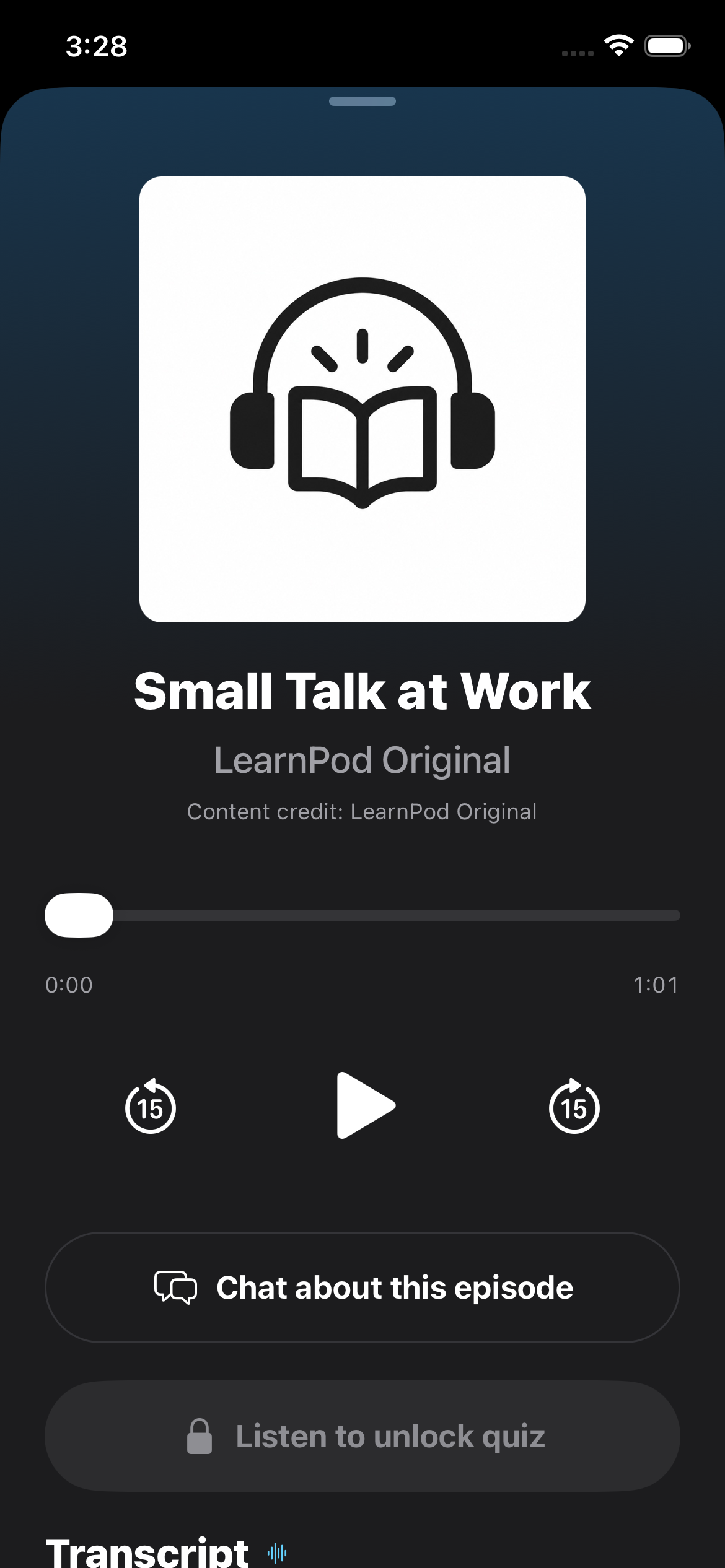
LearnPod uses publisher text included in RSS metadata when it is available, along with bundled first-party text for its own sample lesson. For supported sources, the app can also offer clearly labeled on-device automatic transcription. If the app does not have usable transcript material for an episode, transcript-dependent chat and quizzes stay unavailable.
Build confidence without reading every word
Use the transcript less as your listening improves. Start by checking one difficult sentence; later, wait until the end of a segment. Over time, the gap between what you hear and what you can confirm will shrink. That is a more useful signal than how quickly you can scan the page.
For a complete routine, see how to learn English with podcasts. If you are choosing a source, the guide to learner-friendly podcasts can help you set the right level.