
Start with the kind of listening you need
Different podcast formats build different skills. A short explainer is useful when you want focused vocabulary. A friendly conversation can help with natural turn-taking. A story gives you context that makes unfamiliar language easier to infer. News can work well when you already know the subject, but it may be demanding if every topic is new.
There is no universal best show because your goal matters. A beginner might need a slower, clearly structured format. An intermediate learner may benefit more from familiar topics at a natural pace. An advanced learner can use a favorite interest—technology, culture, sport, history—as material for noticing how people actually speak.
Five checks before you subscribe
- Episode length: Choose a length you can finish and revisit. Five to fifteen minutes is often easier to practice deliberately than an hour-long conversation.
- Predictable structure: Recurring hosts, introductions, and segments reduce the cognitive load of each new episode.
- Topic familiarity: A familiar subject lets you infer unknown language from context instead of stopping constantly.
- Speech pace and variety: Look for speech that challenges you without making the main point impossible to follow. Add new accents gradually.
- Text availability: A transcript can be useful for selected episodes, but do not assume a whole feed has one. Check the episode and publisher information.
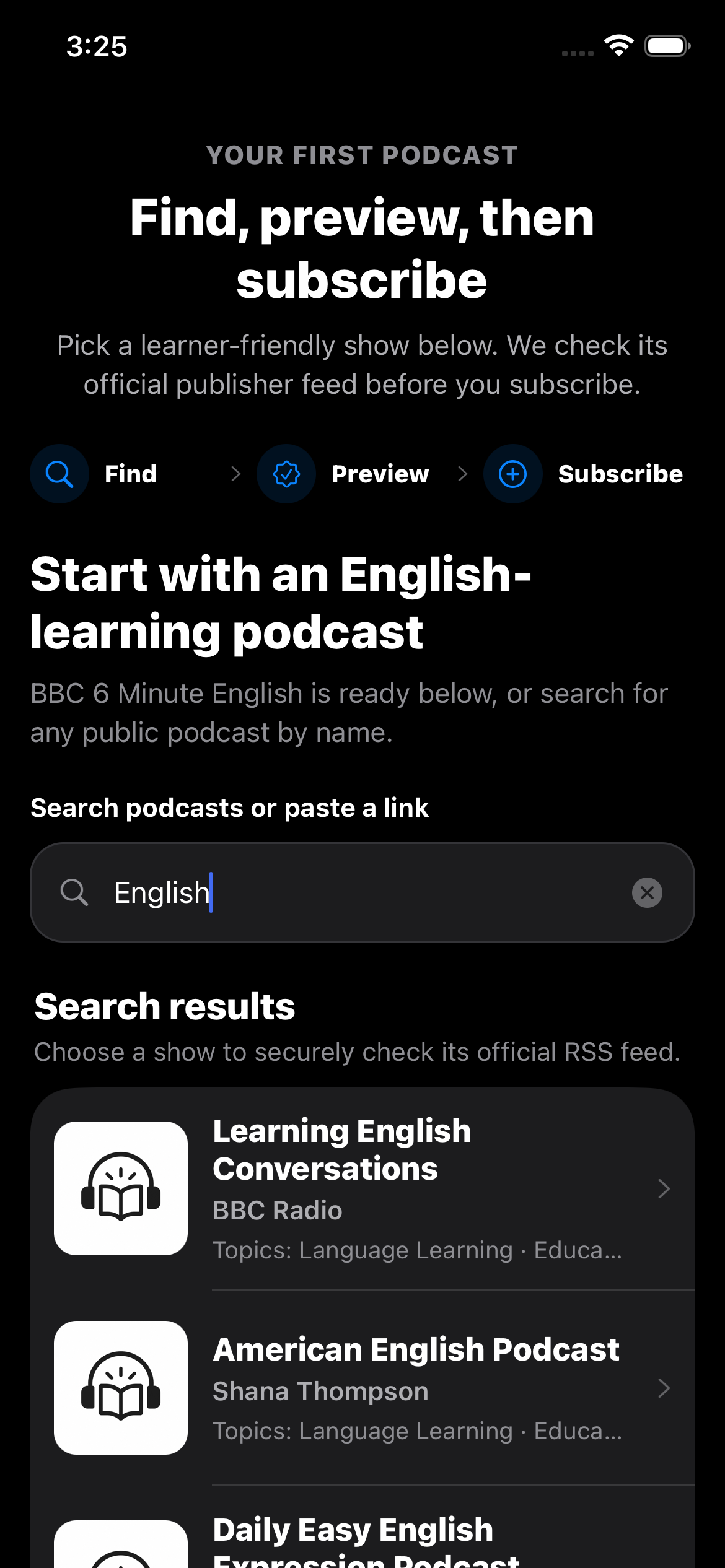
Match a format to your current level
Early-stage listeners
Look for short episodes, clear topic labels, repeated formats, and subjects you know well. Give yourself permission to understand the outline rather than every sentence. Re-listening to the same episode is more valuable than jumping to a new difficult one each day.
Intermediate listeners
Mix one comfortable show with one slightly harder show. Use the comfortable feed to keep momentum, then choose one brief section from the harder feed for transcript-supported practice when text is available.
Advanced listeners
Follow your real interests. Pay attention to implied meaning, informal phrases, and how speakers manage agreement or disagreement. A short spoken summary after the episode can reveal whether you followed the argument, not just the vocabulary.
Turn a good show into English practice
Once you find a fit, use a light routine: listen for the main idea, replay one difficult or useful moment, use the publisher text if it is available, then recall one phrase or detail later. The guide to learning English with podcasts walks through that routine. If you find a show outside a directory search, add its compatible public RSS feed in LearnPod after reviewing the source.